

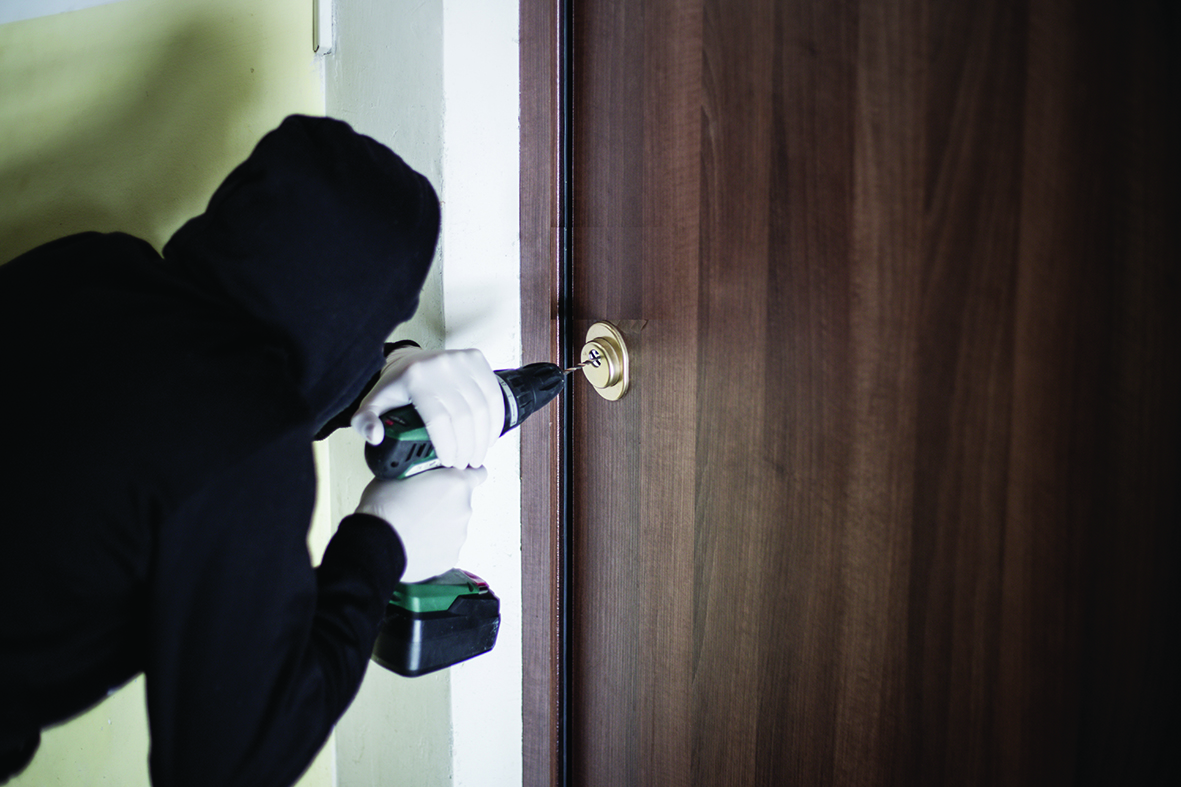
Among the components most exposed to direct physical attacks, the euro cylinder stands out. The cylinder guard was designed precisely to reduce this risk. This guide explains how it works, when it is truly necessary and how to choose the right one.
What is a cylinder guard?
Its function
A cylinder guard is a metal component that wraps around the outer part of the cylinder, leaving only the keyhole exposed. Its purpose: to prevent direct physical access to the cylinder, making outside attack techniques much more difficult.
Several commercial names exist for this product. One of the best known is “Defender”, a registered trademark of Mottura, now part of the Assa Abloy group. As often happens with successful brands, the name has entered common usage to refer to the entire category. In this article we use the generic term “cylinder guard”, regardless of manufacturer.
How it is made
The typical structure consists of a hardened or alloyed steel body, often with rotating or sacrificial elements that spin freely when attacked with pliers, keys, drills or milling cutters. Some models also include a back plate that reinforces the lock area on the inside of the door.
Protection levels: an overview
There are many variants of cylinder guard on the market, often the result of proprietary solutions from individual manufacturers. It is nonetheless possible to identify a useful reference framework with increasing levels of protection. This is a simplification, not a rigid regulatory classification: manufacturers frequently produce variants that deviate from this scheme.
Basic level
The simplest guard is made of hardened steel with a standard shape, with no specific features against pipe attacks. It is easily attacked with this technique, as the outer surface provides a stable grip point for the tool.
Standard with steel cup
An evolution of the basic level adds a steel cup, primarily designed for aesthetic reasons but which, being made of metal, considerably limits the possibility of pipe attacks. This type is also known as “anti-shock”, referring to the greater resistance that the cup provides against direct impacts.
Anti-pipe
At this level, the guard features a specific shape — steps or a tapered sliding profile — that reduces or eliminates pipe attacks, regardless of the diameter used.
One important point: the most critical element of any cylinder guard is not the outer body, but the fixing system. Typically two M6 screws with resistance class 8.8 or 10.8. In a prolonged attack, the real risk concentrates on these screws rather than on the guard body itself.
Anti-pipe with steel cup
Combines the two previous systems, pairing the anti-pipe shape with the steel cup, for an overall level of protection superior to either solution taken individually.
Magnetic or magnetic anti-pipe
The most complete level combines anti-pipe protection with blocked access to the keyhole via a coded magnetic key. A magnetic key with a combination from a few hundred possibilities allows the cover protecting the cylinder keyhole to be opened or closed. When the guard is closed, any manipulation technique requiring access to the keyhole — including bumping and picking — is rendered ineffective.
However, a magnetic guard costs significantly more than an anti-pipe model. Moreover, pairing it with a cheap cylinder does not automatically guarantee the best security compromise. A technique using acids has also been discussed online recently: in practice it is rarely used, only applicable in isolated contexts with long execution times, making it largely irrelevant for opportunistic theft.
Additional technical features
Many manufacturers add technical elements to increase resistance to cutting attacks, regardless of the base level. These include hardened rotating discs, hardened rods or steel balls, positioned to obstruct cutting discs or drills. Such features can appear on products at any level and contribute significantly to overall resistance.
What does it actually protect against?
Cylinder snapping
With snapping, the attacker grips the cylinder with pliers and pulls it forcefully out of its housing, exposing the lock’s internal mechanism. A quality guard prevents the firm grip needed for this operation.
Breaking and fracture
Breaking involves striking the cylinder forcefully to shatter it. A good-quality steel guard absorbs part of the impact energy and protects the cylinder underneath, although no product can guarantee absolute resistance against prolonged attacks with heavy tools.
What the anti-pipe guard does not do
One point needs to be clear: the anti-pipe guard does not protect against bumping or picking. These techniques operate through the keyhole, which always remains accessible to allow everyday use of the lock. The guard addresses a different type of threat — direct physical attacks on the cylinder body — and should therefore be considered a complement, not a substitute for a quality cylinder.
The situation is different for the magnetic guard, which blocks access to the keyhole and therefore neutralises bumping and picking as well.
POTENT cylinder guards are designed to integrate with our cylinder range, offering a consistent level of protection across the entire door. Contact us to find the best combination for your specific situation.
When is it truly necessary?
Particularly exposed doors
For entrance doors of homes, a cylinder guard becomes an essential choice. Whoever attempts a break-in has more time available, and an additional obstacle makes a concrete difference.
Existing cylinders of limited quality
If a full lock replacement is not immediately possible, a guard can represent an effective intermediate measure on an existing cylinder, reducing exposure to the most common physical attacks in the short term.
How to choose the right guard
Compatibility with the cylinder
Not all guards fit all cylinders. The dimensions must match exactly the installed model, particularly regarding the projection from the door face and the body diameter.
Material and construction
Hardened steel guards generally offer superior performance compared to those made of cheaper materials. The critical point is often not the guard body itself but the fixing screws: choosing products with high-grade security screws and non-standard fixing systems further reduces the possibility of tampering.
How to navigate the levels
For most domestic situations, a good-quality anti-pipe guard — with particular attention to the fixing screws — represents a balanced choice between protection and investment, especially when paired with a high-quality cylinder.
A magnetic guard becomes interesting when installing a mid-range cylinder: by blocking keyhole access, it compensates for weaknesses against bumping and picking. However, it should be weighed against the overall investment, as this combination is not automatically the best security compromise.
Want to know which guard is compatible with your POTENT cylinder? Our team is here to help.
Contact us →POTENT’s position
In over 40 years of lock manufacturing, we have learned that door security does not depend on a single component, but on a coherent combination of lock, cylinder and protective accessories. A quality guard only makes sense when paired with an equally good cylinder — the reverse is not equally true.
What we can recommend with certainty is to always evaluate the complete combination, avoiding investing in a single premium component while leaving the rest of the system vulnerable.
Not sure which protection is right for your door? Contact us: we are based in Settimo Torinese and are happy to respond by email.
- What it is: a metal component that protects the cylinder from direct physical attacks such as snapping and breaking.
- Protection levels: from basic guard, to cup, anti-pipe, anti-pipe with cup and magnetic anti-pipe — a reference framework, not a rigid classification.
- Additional features: hardened rotating discs, rods or steel balls increase cutting resistance regardless of the base level.
- Magnetic: blocks access to the keyhole, neutralising bumping and picking — but has a high cost and is not always the best compromise when paired with a cheaper cylinder.
- How to choose: always check compatibility with the installed cylinder, prefer quality materials and screws, and evaluate the investment as a whole.