

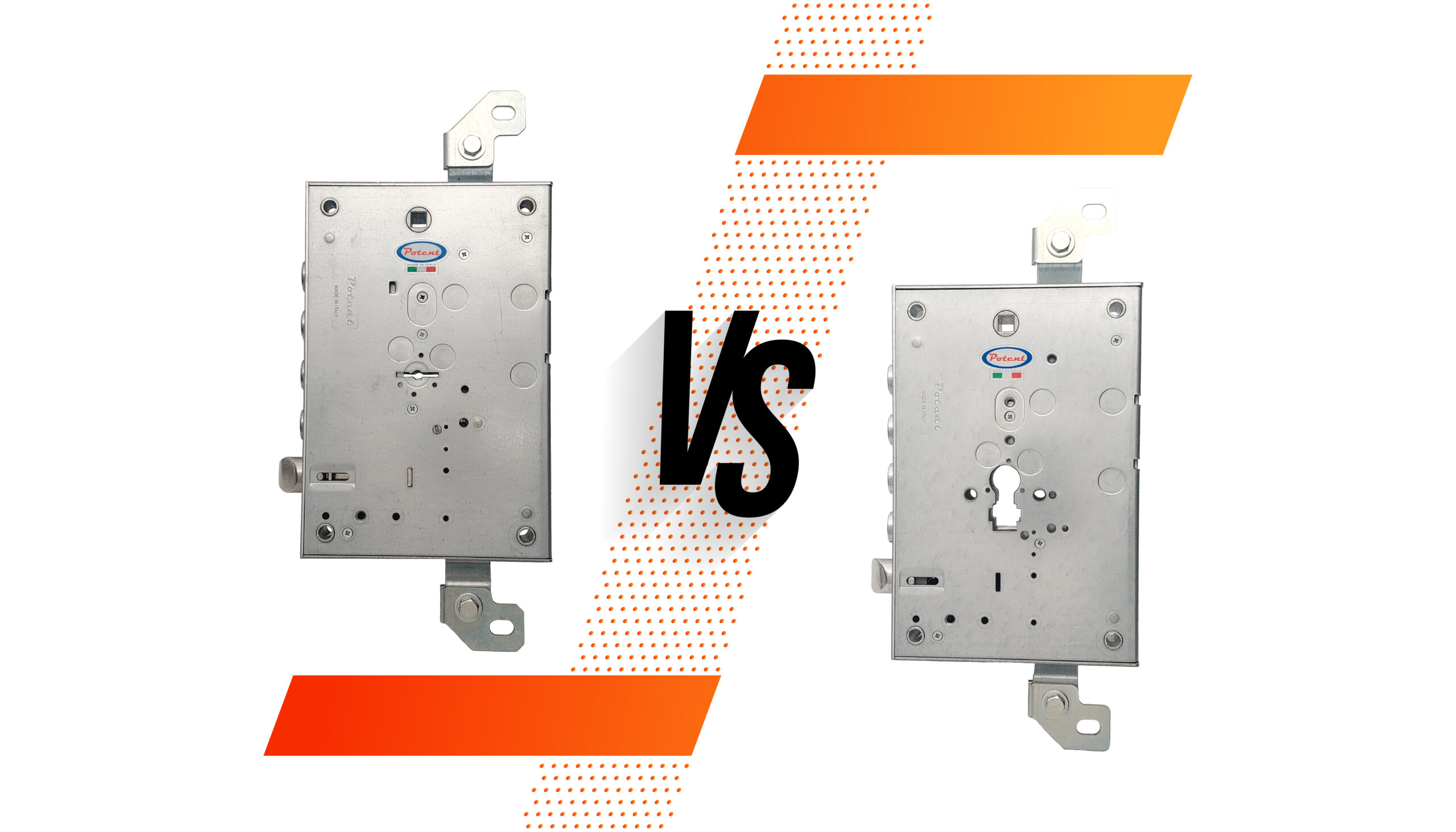
Changing your door lock means first choosing between two systems: euro cylinder or lever lock. Both are widely used, but they work in very different ways. This guide explains how to recognise them, what they offer and — most importantly — which one to choose based on your situation.
How does a lever lock work?
The mechanism
Among traditional locking systems, the lever lock is by far the most common in homes across Europe. The name refers to the key: it has a cut profile on both sides, making it more complex than a simple key.
Inside the lock, a set of levers rise and fall only with the correct key. When the key is turned, one or more steel bolts extend from the lock body and enter the door frame, physically securing the door.
Advantages and limitations
In terms of advantages, the lever lock offers high mechanical resistance: the bolts are robust and difficult to force. It is also generally less expensive than a euro cylinder of equivalent quality, and the integrated system makes it solid against violent attacks. It should be noted that only very few models on the market have a key protected against duplication.
On the downside, the main issue concerns the key itself: in almost all cases it can be duplicated at any hardware shop without authorisation. The key is also bulkier and heavier than euro cylinder keys, and offers lower protection against modern manipulation techniques.
How does a euro cylinder work?
The mechanism
Also known as a "euro profile cylinder", this system is today the dominant standard in new installations. It is recognisable by its characteristic oval shape and its flat, thin key, inserted vertically or horizontally.
Unlike the lever lock, the cylinder is a separate component: it can be replaced independently without removing the entire lock. Internally, a series of pins aligns only with the correct key. Once aligned, the cylinder rotates and activates the locking mechanism.
Advantages and limitations
Among its strengths, the most notable is the possibility of having a key protected against duplication: in quality models, copies can only be made with an ownership card at authorised dealers. Many cylinders also incorporate anti-bumping, anti-picking and anti-drill protection. Another practical advantage is the fast and inexpensive replacement in case of lost keys or change of tenant.
As for limitations, the cylinder is more exposed to direct physical attacks: without a quality cylinder guard, it can be snapped or pulled out. The initial cost is also higher than a lever lock. Finally, quality varies considerably between models: a cheap cylinder may be less secure than a good lever lock.
Direct comparison: which is more secure?
It depends on the model and the context. A good-quality lever lock and a mid-range euro cylinder offer comparable levels of protection against the most common attacks. The real differences emerge in the details.
Key duplication
On the subject of duplication, the two systems behave very differently. For lever locks, except for rare models with protected keys, copying is possible at any hardware shop without authorisation. For euro cylinders, security levels vary considerably, but with patented profile products, duplication requires an ownership card and takes place only at authorised dealers. The choice therefore depends on how much control you want over who has access to copies.
Resistance to bumping and picking
Here too, the two technologies offer different approaches. Many mid-to-high range euro cylinders include anti-bumping and anti-picking protection as standard. For lever locks, the level of resistance to these techniques depends on the individual manufacturer's design choices.
Resistance to brute force
On this front, the lever lock has a structural advantage: the bolts are an integral part of the lock body, making it harder to destroy with crude break-in tools. To compensate for this weakness, the euro cylinder must be paired with a quality cylinder guard, anti-snap and/or with a security plate.
The question of the Bulgarian key
A frequently overlooked point deserves mention. Specific opening techniques for lever locks — such as the so-called Bulgarian key — are only effective if the person attempting the break-in already knows the brand and model of the lock. These tools are purpose-built for specific mechanisms: using them on an unknown lock renders them ineffective in most cases. A concrete advantage, especially when the brand is not recognisable from the outside.
POTENT cylinders incorporate specific protection systems developed over 40 years of manufacturing. Contact us to find out the technical specifications of the model best suited to your door.
When to choose a lever lock
This solution remains valid in specific situations. It is preferable when the door is already fitted for this system and replacement would require significant structural work. It should also be considered in contexts where key control is not a priority, or when the budget is limited: it is better to invest in a good lever lock than in a lower-quality euro cylinder.
When to choose a euro cylinder
For a private home, the euro cylinder is almost always the recommended choice. It provides control over key copies when needed — an important consideration when changing tenants. In rental properties it allows the owner to track all keys in circulation. It is also the natural choice for those seeking maximum anti-manipulation protection and for modern security doors, almost all of which are designed for the euro profile.
Discover the POTENT range of locks and cylinders: Italian quality since 1978, for every security need.
View products →POTENT's position
At POTENT we have been manufacturing both systems for over 40 years, and our answer is always the same: there is no universally right choice. There is the right choice for your door, your context and your needs.
What we can say with certainty is that the quality of the component matters more than the category: a low-end euro cylinder is less secure than a quality lever lock, and vice versa.
Not sure which system is right for your door? Contact us: we are based in Settimo Torinese and are happy to answer by email.
- Lever lock: robust, economical, solid against physical attacks. Specific break-in techniques (Bulgarian key) are only effective if the brand is known.
- Euro cylinder: possibility of a protected key, resistant to modern manipulation, fast replacement. Must be paired with a quality cylinder guard.
- In both cases, the quality of the individual product is decisive: always choose based on the certified security class.