

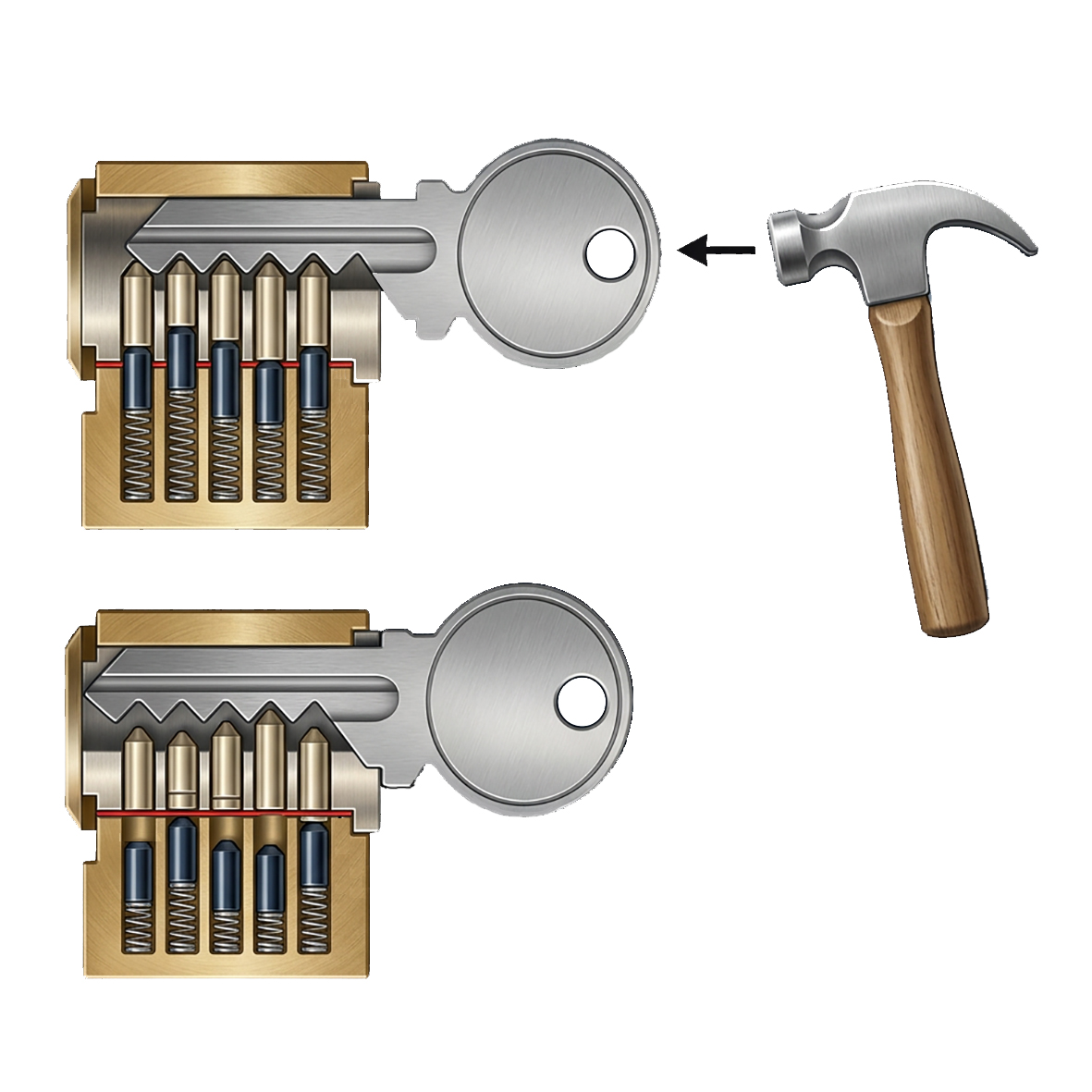
Bumping is a break-in technique that allows many euro cylinders to be opened in seconds, without leaving visible traces. Understanding how it works is the first step towards choosing the right cylinder and being prepared.
What is bumping?
The technique
Bumping takes its name from the “bump key” — a specially modified key that is inserted into the cylinder and struck with an object, usually a small hammer. The mechanical impulse momentarily causes the internal pins of the cylinder to jump, creating a fraction of a second in which the mechanism can be rotated.
The technique has been known among locksmiths for decades, but only became a real security problem when instructions began circulating freely online. Today anyone can find demonstration videos and purchase ready-made bump keys.
Why is it dangerous?
The most insidious feature of bumping is that it leaves no obvious signs of break-in. The door is not forced, the cylinder is not damaged. For victims of a burglary, it is difficult to understand how it happened. For insurance companies, the absence of visible damage can complicate the recognition of a claim.
Another critical factor is speed: an experienced person can open a vulnerable cylinder in a matter of seconds. Time is one of the main deterrents against theft — a fast technique eliminates this advantage.
Which cylinders are vulnerable?
The problem of standard pins
Vulnerability to bumping depends on the internal construction of the cylinder. Cylinders with standard pins, counter-pins and springs — which still represent the majority of low-to-mid range products on the market — are the most exposed. The physical principle behind bumping exploits precisely the simplicity of this mechanism.
There is no specific certification against bumping — it is important to say this clearly. Some products carry the label “anti-bumping” on their packaging, but this is a commercial designation, not a regulatory standard certified by third-party bodies. Real resistance depends on the manufacturer’s design choices.
What makes a cylinder more resistant?
Cylinders that offer greater resistance to bumping share certain design features. The presence of pins and counter-pins with special geometries, or additional blocking systems, reduces the effectiveness of the mechanical impulse. Material quality also plays a role: hardened steel pins or counter-pins, nickel-plated pins and counter-pins respond differently to those made of standard brass.
An often underestimated aspect concerns the key profile. Cylinders with a complex key profile — with more coding points and lateral grooves — make it harder to build an effective bump key, since the key must match the profile to be inserted correctly.
POTENT cylinders incorporate design solutions developed over more than 20 years of dedicated engineering that increase resistance to manipulation attacks, including bumping. Since there is no specific anti-bumping certification, the build quality of the individual product remains the most reliable parameter for assessing real resistance.
How to protect yourself from bumping
Choosing the right cylinder
The first line of defence is the choice of cylinder. Relying on products of proven quality, preferably from manufacturers with a track record and reputation in the sector, significantly reduces the risk. A cheap cylinder purchased online from an unknown manufacturer offers very limited guarantees against modern manipulation techniques.
It is also worth considering the certified security class according to the European standard EN 1303. Although this standard does not include a specific test for bumping, class 4 and above cylinders are generally built to quality standards that make any type of attack more difficult.
The role of the cylinder guard
A quality cylinder guard — also known as a “cylinder protector” or “anti-snap rose” — does not directly protect against bumping, but contributes to the overall security of the door. It limits physical access to the cylinder and complicates the operations of anyone attempting a break-in, increasing the time required and therefore the risk of being discovered.
Security is a system
No single component guarantees absolute security. A quality cylinder combined with a solid lock, an adequate guard and a well-built door creates an overall system that requires much more time and equipment to breach. Time is the most effective deterrent against opportunistic theft, which represents the vast majority of cases.
It is worth remembering that most burglars are not specialists: they prefer easy and fast targets. A door that resists for more than a few minutes is almost always abandoned.
Bumping and lever locks
A frequent question concerns the vulnerability of lever locks to bumping. The answer is that the technique was developed specifically for euro cylinders, not for lever locks. The latter have a completely different internal mechanism — based on levers rather than pins — which is not vulnerable to bumping in the traditional sense.
There are, however, manipulation techniques specifically designed for lever locks, such as the Bulgarian key. These are different tools, purpose-built for specific mechanisms, which require precise knowledge of the brand and model of the lock to be effective.
Want to know which POTENT cylinder is best suited to your door? Our team is here to help.
Contact us →POTENT’s position
With over 40 years of lock manufacturing and 20 years of in-house cylinder design, we have seen break-in techniques evolve and have adapted our products accordingly. Bumping is a real technique, not a myth — but it should not be a cause for panic. With the right choices, the risk is drastically reduced.
What we can say with certainty is that investing in a quality cylinder is the most effective measure for increasing home security. There is no universal solution, but there is always the right solution for every door and every context.
Unsure about the security level of your current cylinder? Contact us: we are based in Settimo Torinese and are happy to respond by email.
- What is bumping: a technique that uses a mechanical impulse to open cylinders with standard pins, without leaving visible traces.
- Who is vulnerable: mainly low-end cylinders with standard spring pins. There is no recognised anti-bumping certification.
- How to protect yourself: choose quality cylinders with advanced design solutions, combined with a good cylinder guard and a solid lock.
- Lever locks: not vulnerable to bumping, but have their own dedicated attack techniques.