

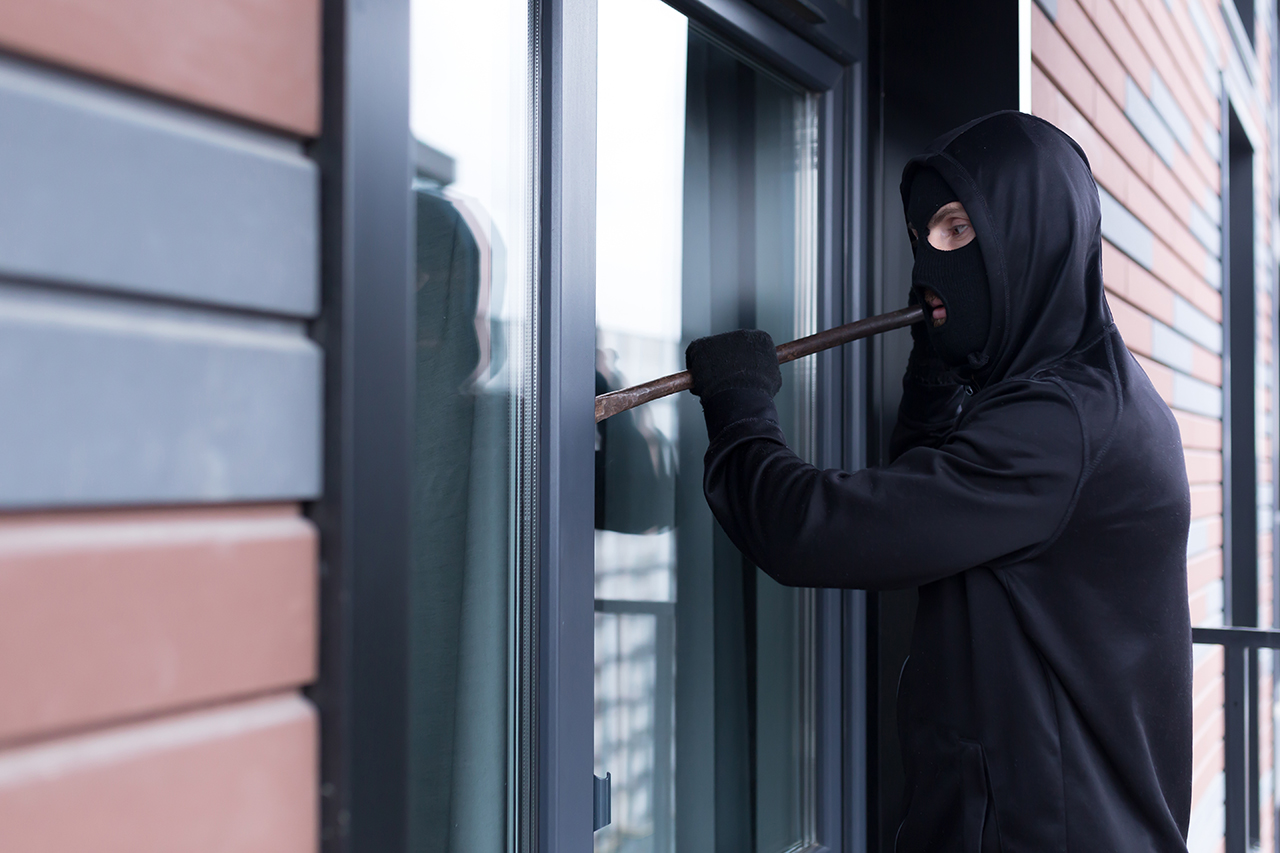
Over 155,000 home burglaries are reported in Italy every year. The real figure is almost double, as many victims never file a report. Understanding the actual data is the starting point for protecting yourself effectively.
The scale of the problem
How many burglaries occur in Italy
According to data from the Italian Ministry of the Interior published in the 2025 Intersectoral Criminal Analysis Report, 155,590 home burglaries were reported in Italy in 2024 — an increase of 5.4% compared to the previous year. This growth has continued uninterrupted for four years, following the drop recorded in 2020 during the lockdown period, when homes were constantly occupied by their owners.
Official reports represent only part of the picture. It is estimated that around 30% of victims never file a report, bringing the real number of burglaries to between 220,000 and 240,000 per year. That is one burglary every two minutes, around the clock, all year long.
Where burglaries are most common
The most affected cities in 2024 were Rome with 8,699 home burglaries, Milan with 3,152, Turin with 2,024 and Florence with 1,803. Lombardy recorded the highest absolute number of burglaries, but when figures are adjusted for population, high-risk areas also emerge across many provinces in central and southern Italy.
A positive sign comes from the first half of 2025, which showed an 8.6% decrease compared to the same period in 2024 — a trend that will need to be confirmed in the coming months.
How burglars get in
The front door is the main entry point
According to the ISTAT 2022-2023 survey, in 28.6% of burglaries the intruder enters by forcing the door — up 9.5 percentage points from 2015-2016. In 30.7% of cases the burglar enters through a window, balcony, garage or a door left open.
In summer, entries through windows and French doors rise to 52.8%, according to the Censis-Verisure 2024 report. Secondary doors such as garages and cellars account for entry in 14.6% of cases.
No forced entry: the invisible burglary
A particularly concerning figure is that around 20% of burglaries involve no visible forced entry: a window left ajar, a door not locked, an open garage. The burglar simply walks in. This type of theft is increasing and also creates a problem on the insurance side: without visible damage to the lock or door, many policies do not cover the loss due to lack of evidence of a break-in.
Silent opening techniques — bumping, picking, the Topolino Decoder — add to this picture: they leave no visible marks even when a locked door has been breached. The practical result is identical: an intact door, no trace, no insurance claim.
When they strike
Contrary to popular belief, burglars do not prefer the dead of night. 38% of burglaries occur between 6 pm and 10 pm — when families go out for errands or dinner. Thursdays and weekends are the most affected days. As many as 40% of burglaries occur during holidays, when absence is prolonged and predictable.
One figure worth noting: 13% of burglaries take place while the owners are at home. Burglars often take advantage of a moment of distraction or a different floor of the property.
What they take
The bedroom is the most targeted room in 70% of cases. The most stolen items are jewellery and watches (80% of cases), cash (60%) and electronic devices such as computers and phones (40%). The average duration of a burglary is just 10 minutes — time is the critical factor both for the burglar and for anyone seeking to protect their home.
The profile of the opportunistic burglar
Who they really are
The vast majority of home burglaries are committed by opportunistic thieves, not trained professionals. They work alone or in pairs, without a precise plan. They look for the easiest target: no security door, no visible alarm, a quiet area, clear signs of absence. If they encounter resistance, they move on to the next target.
There are also more organised gangs that carry out reconnaissance and study residents’ routines. These are a minority, but they use more sophisticated tools such as the Topolino Decoder. They target specific buildings — often blocks of flats where many apartments have the same cylinder fitted as standard.
The time factor
What almost all burglars share — opportunistic and organised alike — is sensitivity to time. Every additional minute spent outside a door increases the risk of being seen, captured on camera or surprised by someone passing. A burglary planned to last 10 minutes becomes risky if simply gaining access to the property already takes 5.
This is the principle on which all deterrence logic is built: not eliminating the risk of burglary entirely — which is impossible — but raising the time, difficulty and risk for the burglar sufficiently to make the attempt not worthwhile.
Deterrence: why it works
The basic principle
A burglar assesses every target in terms of the balance between risk and reward. A home with a security door, visible cameras, window bars and an alarm system is a target that requires more time, more equipment, more noise and more exposure. For an opportunistic burglar — seeking the easiest property in the shortest time — it is simply a target to skip in favour of a less protected neighbour.
There is no need to make your home impenetrable. It is enough to make it harder to enter than the available alternatives nearby.
The elements of deterrence
A certified security door is the first visible signal of resistance. Anyone forcing it must make noise, use heavy tools and spend time. CCTV cameras — even just visible ones — increase the perceived risk of identification. Window bars physically eliminate a main access point.
The system matters more than any single element
An alarm system, even just a visible external siren, adds a further risk element. Each of these elements reduces risk individually. Combined, they multiply it — because every additional obstacle increases the time needed to enter and with it the cumulative risk for the burglar.
The cylinder within the deterrence system
Within this system, the door cylinder plays a specific role: it determines how much time and what tools are needed to open the door without a key. A quality cylinder, resistant to modern manipulation techniques such as bumping, picking and decoder tools, is not an absolute guarantee — but it is a concrete obstacle that adds to the other elements of the system.
A cheap cylinder fitted to a certified security door is the weak link in the system — it is faster and simpler to attack the cylinder than the door itself. Investing in a good lock and then neglecting the cylinder is a common mistake that undermines part of the investment in the door.
With over 40 years of lock manufacturing and 20 years of in-house cylinder design, we have learned that home security does not depend on a single component. Lock, cylinder, guard and overall deterrence system must be consistent with one another. Contact us for an assessment of your current locking system.
A note on insurance
One practical aspect that is often overlooked deserves mention. Home insurance policies almost always require proof of forced entry — visible signs of damage to the door or windows. Burglaries without visible forced entry (unlocked door, silent technique, secondary access) may not be covered, or may generate disputes with the insurance company. Documenting the quality of your security systems — certifications for doors and cylinders, alarm systems, cameras — is something that can make a real difference in the event of a claim.
Want to assess the security level of your locking system? Our team is here to help.
Contact us →POTENT’s position
The data on burglaries in Italy is clear: the phenomenon is growing, techniques are evolving and the statistical likelihood of being affected is real for everyone. This is not a reason for panic — it is a reason to make informed choices.
Deterrence works. Not because it makes burglary impossible, but because it moves the burglar towards easier targets. A home that offers resistance — certified security door, quality cylinder, adequate guard, cameras, alarm — is a home that in most cases will be passed over in favour of the next. In the context of opportunistic theft, which accounts for the vast majority of cases, this is enough.
Do you have questions about the security of your home? Contact us: we are based in Settimo Torinese and are happy to respond by email.
- 155,590 burglaries reported in 2024 — up 5.4%. The estimated real figure is around 240,000.
- How they get in: forced door (28.6%), windows and secondary access points (30.7%), no forced entry (20%).
- When: 6–10 pm, Thursdays and weekends, during holidays. 13% while owners are at home.
- The time factor: 10 minutes average duration. Every obstacle added increases the risk for the burglar.
- Deterrence works: security door, quality cylinder, cameras, window bars and alarm combined multiply the burglar’s risk and concretely reduce the probability of being targeted.